Why does the water look strange during a strong wind?
The glint phenomenon
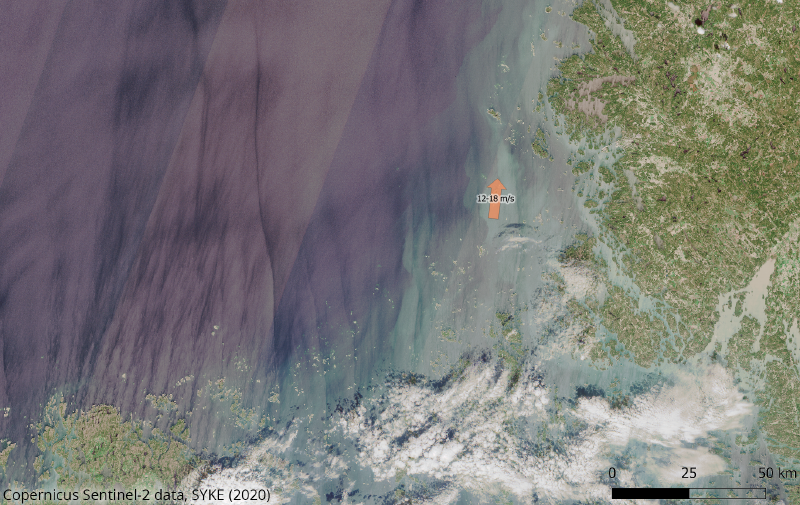
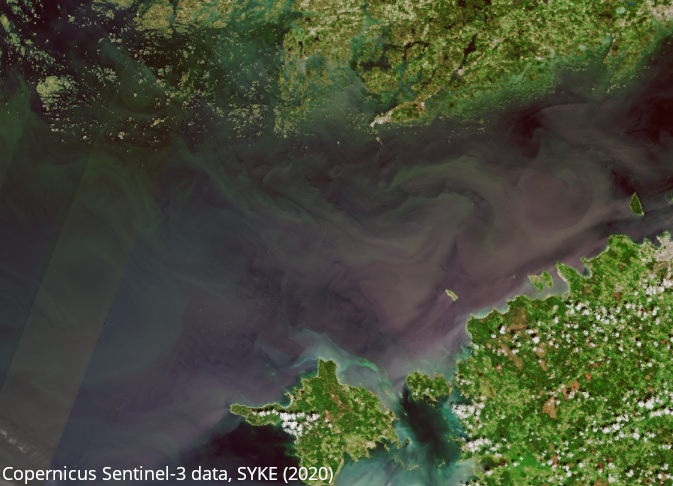
Among other things, during strong winds, the water may look gray or otherwise strange in color. In this case, it may be glint, i.e. the flickering of sunlight caused by surface waves. Optically, it is a matter of directional reflection; glint is usually strongest in a specific direction which depends on the position of the Sun on the sky and the main directions of the surface wave field.
You can see the glint, e.g., in true-color images when the water surface reflects sunlight directly towards the satellite instrument. This situation is mostly due to surface waves raised by wind blowing in the appropriate direction. In this case, there seems to be a gray cover on the surface of the water, under which it can be difficult to distinguish the real features of water quality (see the first example below).
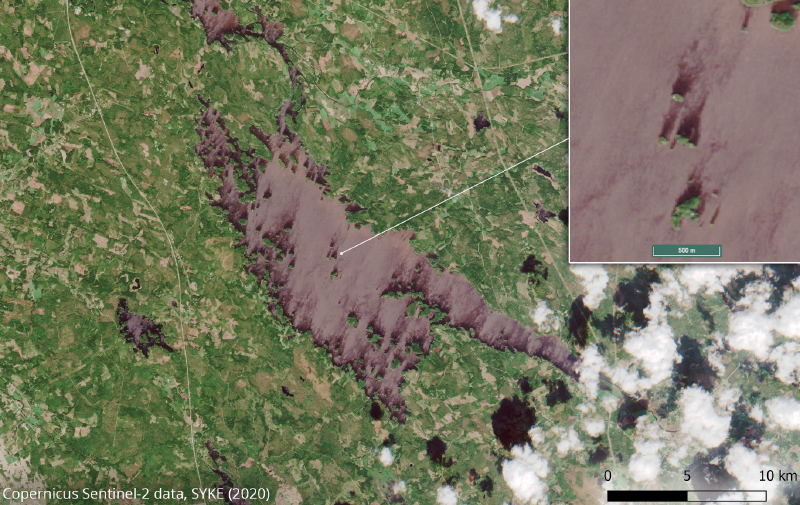
The glint is also recognized by a peculiar phenomenon in which the islands seem to leave long shadows in the downwind direction (see another example below). This is especially noticeable in lake areas. It is not an optical shadow area, but the effect of the island on surface waves and wind speed within its wake. Also, the atmospheric gravity waves and substances floating on water surface, such as oils, can equalize the surface wave field and modify the glint pattern.
More information about the phenomenon can be found in English on NASA’s Earth Observatory website.